
Are You Managing the Contractor, or Accidentally Owning the Risk?
Sharing a site doesn't mean sharing the work. Here's why managing contractors and managing employees are not the same job — and where that gap turns risky.

There is a recent NSW case worth paying attention to if your business engages contractors for specialist or high risk work.
The case is SafeWork NSW v Boral Cement Limited (No. 2) [2026] NSWDC 88. Boral was found guilty after a contractor’s worker was seriously injured during maintenance work at Boral’s New Berrima site. The job started one way, but partway through the plan changed. When that happened, the risks changed too. But the new approach was not properly checked, Boral’s own safety processes were not followed, and the specialist equipment provider was not brought back into the conversation before the work continued.
The easy takeaway is: “You cannot handball safety just because you engaged a contractor.”
And whilst that is true, the reality of contractor risk is way more nuanced than that because managing your own employees and managing specialist contractors are not the same thing.
With your own team, you usually have a much higher level of control. You direct the work. You train the people. You set the systems. You supervise the task. You decide how the work is done.
Contractors are different.
A contractor is often engaged because they bring specialist expertise you do not have internally. That matters. The way you manage the WHS risk for a contractor should reflect the nature of the contract, the expertise they bring, and what you control or influence. Duties owed to contractors are not met in the same way as duties owed to employees, because control, influence, the contract and the expert nature of the work all matter.
That does not mean you can wash your hands of it.
If the work is happening on your site, around your people, inside your operating environment, under your permit system, or affected by your production pressures, you still have WHS responsibilities. Under our WHS laws, more than one business can hold duties at the same time. So yes, if contractors are coming onto your site, you absolutely have duties in relation to their health and safety. You do not get to wipe your hands of it just because they are employed by another business.
But I need you to understand this:
How you execute those duties matters.
Because the fact that you share duties does not mean you should blindly insert yourself into the contractor’s specialist work.
That is where businesses get themselves into trouble.
If you start dabbling in the contractor’s bread and butter, the specialist work they were engaged to do because they have the expertise, you can blur the lines very quickly.
Think about it in everyday terms. If you engage an electrician to install a new light at your house, you do not ask them to hand over their work method and start telling them how to wire the fitting. Of course you don’t. You engaged them because they are the specialist.
But that does not mean you have no role. You still manage the things within your control. You make sure they can access the area safely. You tell them if there is something unusual about the house. You keep kids and pets away from the work area. If they need the power turned off, you do not flick it back on because it is inconvenient.
That is the distinction. You do not take over the electrician’s specialist work, but you do manage the parts of the job that overlap with your home, your people and your environment.
That is how we need to think about WHS management for contractors.
In a business context, the stakes are higher, the duties are clearer and the risk profile is more complex, but the principle is similar. You do not need to take over the contractor’s specialist work, but you do need to manage the parts of the job that overlap with your site, your operations, your people, your plant, your systems and your risks.
This is the fine line in contractor management.
Do too little, and you may fail to manage the risks that sit within your site, your operations, your people and your systems. You may fail to protect contractors from the things you expose them to.
Do too much, without the right expertise or clarity, and you may create confusion about who is managing the work, who is making the safety decisions, and who is responsible when the method changes.
That is why contractor management cannot just be a pile of paperwork.
We need to be clear on the basics before the work starts:
What do we control?
What does the contractor control?
What expertise are we relying on them to bring?
What risks exist because of our site, our operations, our people or our plant?
What risks does their work create for us, our workers and others on site?
What happens if the work changes?
Who has authority to stop the work?
And who needs to be brought back into the conversation before the job continues?
Because if those answers are not clear, contractor management becomes messy very quickly.
That last question matters, because change is where risk loves to hide.
The plan changes. The equipment does not behave the way people expected. The shutdown window is tight. Someone makes a practical call to keep the job moving. Everyone is under pressure, and suddenly the work being done is not the work that was risk assessed and agreed to.
That is the moment contractor management matters most. Not when a contractor is being prequalified. Not when the work is standard and by the book. When the job, or the environment around it, changes.
The answer is not to micromanage specialist contractors, but the answer is also not to step back and assume the contractor has it covered.
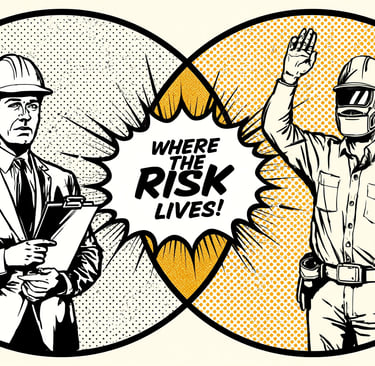
The answer is to be crystal clear on the parts of the job that overlap with your site, your people, your operations and your risks. Where is the risk? What are you responsible for? What are they responsible for?
Because when the work changes, the risk changes.
And if no one is clear on who is managing what at that moment, that is where risk lives.
If you’re interested, check out my colleague, Sue Bottrell’s article / webinar on the Boral case: